Sunday, 17 July 2016

Teaching English in China: Part One

Another thing this blog has lacked is mention of my experience teaching in China, which is pretty poor on my part considering it made up a significant part of my time when I wasn't off swanning around China. So where to begin?

一。Typical work week

On average, I worked around 16 hours a week teaching 20 different classes of students aged between 13-15 years old. I was one of the lucky ones. Before getting to China, I was told I could be teaching class sizes of up to 60 or 70 with varying degrees of English but I was fortunate enough to only have 20 students per class and only ended up teaching as many as 50 in the last few weeks of my final semester. Classes were spread across the working week, but often I would get Wednesdays off which was handy to have a little mid-week break to do whatever I wanted. I ended up having my weekly Chinese lessons on this day and it made for a good routine to study and practise until my evening classes. All in all, my teaching time table was pretty well scheduled which gave me a good amount of time to prepare my lessons, pursue other hobbies and not be too tired out by the end of the week.

二。Typical work day

If there's been anything that has made me appreciate my school life more, it's the ability to compare my school experience with that of a typical Chinese student. First classes began at 7:35am sharp and last classes finished at 5:15pm. At least two out of three of my working days began from first lessons and as much as I'd like to complain about such early starts, I never had to teach a full school day and was often finished by around 2pm in the afternoon.

Lessons lasted for 45 minutes with a ten minute break in between. Students had about three "breaks" during the day. Morning break, which began at 10:10 until 10:35, was dedicated to a flag raising ceremony on a Monday, and/ or morning exercise. You might have seen it on TV before, but this is when students launch into a synchronised exercise routine as a form of fitness. It wasn't uncommon for my students to return from morning break a little out of breath.

Lunch began around 11:20am for around an hour. It was strange at first to each lunch so much earlier than normal but considering the early starts, I was almost always really ravenous by this time so I welcomed early lunches. I'd often eat in the school canteen on working days. I was given a teachers meal card which was loaded with a monthly allowance and gave me meals for as little as 10元 (£1). The lunch offering changed on a daily basis and it was always a nice surprise not knowing what we might get on a given day. Here's an example of a school meal I got:

Fish/ Chopped courgette with chicken (?)/ Rice/ Mixed brocolli and cauliflower/ Potato smileys 

Potato-bloody-smileys! Of all things I didn't expect to see in China, classic school dinner potato smileys were not one of them! But needless to say, I was always chuffed whenever I walked into the canteen with this on the menu.

After lunch, the kids were always a little more energised which made teaching after such an early start a bit easier. At 3:05pm, students have noon break. For the most part, they were given actual rest time, but often, they'd have to do eye exercises which attempt to improve vision. Luckily, I never had to teach later than 3:05pm so my day was pretty much over by this point. I could return to my room, whack on an episode of Modern Family and unwind.

三。Some differences in education culture

As I said, I really came to appreciate my school life more after being able to compare it to what the average Chinese student has to endure. Breaks during the day was just the tip of the iceberg. I often felt sorry for my students that they didn't have the same opportunities to kick around a football for an hour like the boys I knew from school would during the lunch break, or just sit around with their best friends and just chat like I did at school.

If they weren't doing exercises or eating lunch, my students could most likely be found scribbling away at homework they weren't able to finish or mouthing to themselves passages they were told to memorise for examinations. For them, education did not stop when they left school. My students often told me that on average, they'd stay up until midnight to complete all the homework they had been given during the day. Even on weekends, they weren't given much time to relax and instead would be taking extra classes to get ahead (or to keep up) and get top scores in the class. It's a well-known stereotype that Chinese students are incredibly hard-working and from what I experienced of teaching in China, I can vouch for that. But admittedly, it was a little disheartening when some of my students would come up to me and express their disappointment in that they came only sixth best in the class and really beat themselves up about the silly mistakes they made out of stress and anxiety. I for one was incredibly proud of the vast majority of my students and how far they'd come in terms of oral English compared to when I first met them. But there's only so much you can say to console them.

The reality is that education is really competitive in China. Every student strives to be the best, not just for themselves but also for their parents and families. But with every student aiming for the same thing, it makes it much more difficult to shine and stand out. One thing that I really did like about my classes though was the sense of family. There isn't really such a thing as 'sets' or separating students based on ability in China. It's something that I believe makes a lot of difference in the way you can teach but the sense of family amongst each class means that each student helps to pull one another up when they're falling behind. There's a genuinely strong familial bond amongst students which is really heart-warming to observe and it's perhaps something that's not seen quite as much in the UK education culture. In spite of the competitive nature and need to highly achieve in China, there's still a sense of wanting to help each other out to ensure your family stays together and no man is left behind. Certainly, family is a strong value in Chinese culture and it can be seen in the classroom too.


SHARE:

Wednesday, 6 July 2016

10 Reasons To Live In China One Day: #2

二。Taste real China

If you think you love Chinese food now, then wait until you get to China and taste real authentic Chinese food. Everyone's got their own favourite local Chinese takeaway. You might even know what numbers to call out over the phone when you order your usual favourites on a Friday night - but the 'delicious' guilty treat that comes in a plastic tupperware box with some complimentary prawn crackers is far from the real deal. 

Hot pot set up (火锅) 

As a foreigner in China, it's not hard to come across a 'western' restaurant to eat all the things you're used to. Even I was prone to going for pizza every now and then when I wanted to change things up but for the most part, I ate Chinese food so as to integrate myself into the culture as much as possible. Over the course of the year, I've managed to visit many Chinese cities and one of the main things I attempt to do is to try THE must-eat thing. Without this goal, I wouldn't have tried some of the best food I've ever tasted or developed new favourite things to eat. RouJiaMo (肉夹馍) in Xi'an is genuinely one of my favourite things ever and I'm certainly going to miss being able to get it from a street vendor if I get a craving.

RouJiaMo (肉夹馍) in Xi'an 

One of the greatest things about Chinese cuisine is that it is so varied. Each province or city has their own speciality, and for the most popular types of food (noodles, dumplings, bao etc), there's still a lot of local variation. Take for example Tianjin, where I've been living for the past year. Tianjin specialises in 'snacks'; from fried dough twists to 'fried ear hole cakes'. The municipality is also famous across China for its 'Go Believe' baozi (a white bready bun, typically filled with meat). Tianjin also lays claim to a famous egg pancake based breakfast food called 'Jian Bing Guo Zi' (煎饼果子)- although I have come to find out that it's sold and eaten over much of China, but it does indeed taste a little different depending on where you are. But that's my point exactly. No matter where in China you are, you can be sure the typical cuisine has a local take on it, making it hard to resist sampling all food to discover its variation. 

Sharing food with newly made friends

The food culture in China is also centred around sharing food. It is common for families or groups of friends to cook or order many dishes to be shared amongst the entire table. I'm used to this style of eating at home but I don't think I ever truly appreciated the sociability of this kind of food culture until I came to China. Not to mention the fact that you get to try so much more than if you simply order one thing for yourself. It's a complete win-win situation for all!

Yak, mushroom and mint in Yunnan Province

Provincially, each place also has its own 'thing'. Whether it's the spiciness of Sichuan, the Peking duck of Beijing, the dim sum or morning tea of Guangdong or the yak based meals in Yunnan - there is simply so much to try and it's all delicious in its own way. For the more adventurous, China also serves some of the strangest foods I never thought I'd become so fond of. Personally, I've taken quite a liking to spicy duck neck but it does get even more odd with the likes of snake or the stomach of various other animals appearing on menus. 

Fried scorpion on sticks found in the snack streets of Beijing

All I know is my eyes have been opened to so much more in terms of Chinese food. I've always appreciated it. In fact, my Dad is a chef so the food I eat at home has always been top quality Chinese food but it has to be said, my Dad has to step up to the plate now I've discovered so much more about the taste of China. It's not all sweet and sour chicken or egg fried rice - there's a whole lot more to explore and China is the place to do it if you want to do it right!


SHARE:

Saturday, 28 May 2016

Last Stop: Guilin & Yangshuo

Sun and Moon Pagoda, Guilin

It has to be said, for any traveller in China, Guilin is a must on any travel list. Famous for it's beautiful rice terraces and countryside lifestyle, I'd been told to head to Guilin way before I'd even arrived to China. It seemed only apt then that I made it one of my last stops during Spring Festival. Here, Beth and I were reunited again with Tom and we'd met some really lovely people at our hostel, who we ended up spending the rest of our time with until we returned to Tianjin - marking the end of our Spring Festival travels.

一。Reed Flute Caves

It was pretty cold and rainy when we got to Guilin. We arrived on Valentines Day. It's not something I've ever actively celebrated but Beth and I decided to 'celebrate' by grabbing some western food and later met up with Tom for a little explore of the nearby town area - making our first day there pretty chilled out. The following day, we took a little bus trip to check out the Reed Flute Caves, an impressive tourist attraction consisting of caves over a thousand years old filled with stalactites. Although it's artificial, the stone formations are lit up with rainbow coloured lights, making the whole experience quite trippy but beautiful.


Each formation is named after something it resembles. For example, 'The Mosquito Net', 'The Fairyland' or 'The Snowman'. It might takes some relaxing of the eyes or some squinting, but it makes for a fun, if not abstract, game to play whilst you're there.


After finishing the cave tour, we bumped into a few people who happened to be staying at the same hostel as us. As a group of foreign tourists, equally indecisive but up for anything, we all decided to spend the rest of the day (and in the end, the rest of our time in Guilin and Yangshuo) together.


One of the best things I found about Guilin was how incredibly friendly everyone was. There were many occasions where we were stopped in the street for photos. Especially sweet were the little kids that approached us to welcome us to their hometown and practise their English (which was impressively good for their age if you ask me). 

二。Blame it on the River Li

We'd had such a nice day exploring Guilin together, we managed to convince our new friends to change up their plans and come to Yangshuo with us the next day. We took a bamboo reed boat up the famous River Li where you are surrounded by amazing karst mountains and are able to really take in just how beautiful China can be.


Even better is that you can compare the surroundings with the scenery presented on the 20元 note.

Living the actual 20元 life

It's a slow and easy ride along the river which serves as a better way to get to and from Guilin to Yangshuo as opposed to a bus you can take. When we arrived in Yangshuo, we got stuck straight in by trying out the locally renowned dish of beer fish. It's genuinely delicious and I think that if we had known each other longer, we'd probably have been less polite and ravaged the entire plate much quicker than we did. Beer fish is a must try if you're in Yangshuo!


三。Countryside Cycle

So I hinted back when I first started writing this Spring Festival series that during my travels, I'd come away with approximately 10 bruises and crashed into 2 people. It shouldn't come as a surprise then that both were the result of me taking to the streets on a bicycle, despite the fact that I'm absolutely terrible on a bike. By this point, I hadn't ridden a bike for any extended amount of time since I'd been to Xi'an in November - and even then, it was pretty touch and go. But when one of the 'must-do' things in Yangshuo is to take a relaxing and scenic bike ride out to the countryside, you gotta do what you gotta do...


Despite my terrible cycling ability which left me with quite a few bruises, scrapes, a bit of a dodgy shin and some ripped jeans, I did genuinely enjoy the ride (when I wasn't almost riding into canals... or other people). It was the first time we'd had genuinely lovely weather so we definitely picked a good day to go and although this is a 'touristy' things to do, the cycling routes aren't over crowded and you can really enjoy the unique Yangshuo landscape in the sun. My only tip would be to rent a mountain bike rather than the basic ones on offer. It only costs a little more to rent the bike for the day, and it's worth it if you're planning to go a long distance.


四。Fuli Village


On our last full day in Yangshuo, Beth and I decided to explore one of the nearby villages which is famed for the creation of hand painted silk fans. We took a very rogue looking 'bus', arriving in what seems like 'real China'. People lazing around in the shade on a sunny day, people visiting the local market to buy whatever vegetables and meat they needed for their dinners, people getting their haircut at outdoor barber shops. In Fuli Village, you'd never guess you were a mere 45 minutes away from the more tourist-y Yangshuo.

We strolled around the winding backstreets, peering into the open doors of people's homes to find families crowded around a TV or drinking tea. We also came across a few shops displaying and selling silk fans and were lucky enough to watch a craftsman at work.


He was happy to just let us observe so we stood for a while as he added small details to his paintwork.

六。Not quite done yet...

Although I haven't mentioned in detail every little thing we did during our days in Guilin and Yangshuo (amongst other things, we went to a trapsed up and down the busy and bustling West Street, tried our hand at dumpling making for our own dinner at the hostel, watched the impressive Yangshuo Sanjie Lui Impressions show and had a great last few nights at some of the local bars, complete with beers, dice games and a hilarious few rounds of Cards Against Humanity), I don't feel like I'm quite done with either of these places. After my first few days in Guilin, I'd already felt like it wouldn't be the last time I'd visit. There's so much to do and see in both places so it certainly won't be my last time to visit.


The plane back to Tianjin was bittersweet. I was ready to get back to Tianjin and rest up before I had to start teaching again, but we'd also had a really great few days making new friends and ending our Spring Festival travels in some of China's most popular spots. But there we have it, 37 days and lots of places in China ticked off my list! As exhausting as it was at points, given the chance, I'd do it all over again...


SHARE:

Saturday, 27 February 2016

Chengdu-ing it

Spot the panda

Chengdu - capital of China’s western Sichuan Province and city iconically known for being home to giant pandas and spicy cuisine. Enter Annie and Beth in full tourist mode, seeking to immediately tick these two things off the Chengdu must-do list. I couldn’t possibly come to China without visiting at least once so I made it the first stop on my travels. So, for my first post on my first Spring Festival stop, here are my Chengdu highlights:

一.Hot Pot

The night prior to leaving for Chengdu, I’d spoken to a fellow expat in a bar in Tianjin about the must-do things in the city. His answer: try Sichuan style hot pot. 

Me and Beth about to enjoy hot pot with a new friend

Now, I’m partial to a good hot pot. In the winter climate of Northern China, hot pot is the perfect meal to enjoy to ward off chilly winds but according to this guy at the bar, Sichuan hot pot was (in his words) “melt your face off” spicy.

“First, you think you can take it, and then your lips start to tingle. And then you can’t feel your lips. Then, come the sweats as your tongue feels like it’s about to explode. You’ve probably swallowed one of those sneaky peppercorns as you feel your face about to set on fire.”

Boy, did this guy paint a picture. Now, I’m by no means a spice wuss, but he did scare me a little about the level of spice I might have to face if I tried a genuine Sichuan hot pot. Not enough though – it was one of the first things Beth and I did on our first night in Chengdu. We ventured to Shu JiuXiang Hot Pot Restaurant (蜀九) in WuHou District near where we were staying. We were assured it was the type of place that stayed open late and offered top notch food.

Having never actually ordered hot pot on our own before, we did a pretty decent job. Our waitress was also pretty helpful with giving us tips on the best combinations for our dipping sauce. We left with full-stomachs but were not quite content with the level of spice we ordered. It wasn’t quite the “melt your face off” experience we were looking for and so the search continued.

On other nights, we tried our hand at spicy noodles yet we were still not satisfied. It was only until our last night when we were taken to a hot pot place upon the experience of a new friend we made on the bus back from Leshan that we got the closest to ‘melting our faces off’. Between us all, we ordered two spice levels of soup base. Sure it was hot but I have to admit I didn’t have tears streaming from my eyes like I thought I might. The food and service was still amazing though and we were even treated to a mini Sichaun Opera mask changing performance which was great fun. I guess the search goes on for a tear-inducing spicy Sichuan hot pot though…

二.People’s Park

On our first full day in Chengdu, our itinerary was entirely open. Maybe it was the chilled out vibe of Chengdu that made us feel quite easy-going about what to do in the city but neither Beth nor I felt like doing anything too strenuous. We spent a good portion of the day in the People’s Park because a guy I was chatting to over Tinder had recommended it as the best place to chill out and grab a relaxing cup of tea at one of the many teahouses.

Obviously I can’t just skip over the fact that I’ve casually dropped in my use of Tinder in this post, but bear with me as I hark back to my summer travels in Japan last year to explain why it’s relevant to mention. I did a solo trip to Japan last summer to visit a good university friend of mine who was, like I am this year, teaching English in Northern Japan. I stayed in a traveller friendly hostel in Tokyo and really enjoyed talking to the stream of backpackers that came and went every day. One guy from Canada particularly stuck out to me though.

“Do you know what’s really good for travelling?” he said. “Tinder.”

“It’s really good for talking to people about what to do wherever you are.”

I remember rolling my eyes and instantly dismissing his comments. Sure mate. It’s definitely nothing to do with the fact you want to pick up a pretty Japanese girl. Of course you’re “looking for tips”…

I have to take that all back though. I’ve found Tinder a really good source for local knowledge and tips for the best things to do and see in any given city. I’d genuinely recommend it as an alternative to looking up stuff to do on Tripadvisor etc. This little anecdote becomes even more relevant towards the end of this post too but that’s another story. As I said, a Tinder tip I received told us to go to the People’s Park and it was a good choice to make.

The sassiest Chinese dance couple in all of the People’s Park

We really enjoyed standing around in the park watching a herd of ‘dancing aunties’ and old Chinese couples break out the moves in a kind of public park strictly come dancing show. We even got involved at one point in a Chinese Zumba style class (although Beth was far more adept at picking up the moves than I was).

I always find it quite incredible that so many people of the older generation in China are such incredible dancers. They’re just so co-ordinated and perform the dances effortlessly. The old couples did take breaks between some dances to catch their breath, but it was also very sweet to have stood on the side lines and watched as old men invited other women sitting on the edges for another cheeky dance.

I couldn’t take my eyes off one couple in particular though. Both nailed every single move and you could see all the other couples around looking over their shoulders for a brief second as they commanded the floor. The woman in particular with her long, butterfly printed velvet maxi skirt just oozed sass. Talk about dance couple goals.

Yep, enjoyed hot chrysanthemum tea through a straw…

It was a lovely little walk around the park itself. Chengdu was just so chilled. We sat down for some tea in one of the teahouses and spent some time people watching. Locals simply enjoying tea as they read the newspaper. Groups of old men getting worked up over their card games. Families with several generations spending time together, grandmas cuddling their adorable baby grandchildren. Here I also discovered how delicious chrysanthemum tea is. It was a random choice to have made in the first place and I can’t deny that I didn’t get it because I knew it’d look pretty but it’s now become one of my favourite teas. 

(*Note to self:- track some down now you’re back in Tianjin.)

三.Pandas


Day two in Chengdu and we went into full tourist mode when we headed to the Chengdu Research Base of Giant Panda Breeding. We bought some panda ears and wore them pretty much all day. We took a tonne of photos, attempting to get the best selfies with the pandas. It was harder than it sounds because the pandas were for the most part snoozing away and pretty inactive. For the ones that were awake, it was a bit of a battle with all the other Chinese tourists who also wanted photos. But you really can’t complain. Pandas are just too cute, whether they’re asleep or not.


I did enjoy letting my inner biology geek loose too. Reading about genetic diversity and the use of studbooks in one of the little museums reminded me of my school days revising for biology exams. Kiri - if you’re reading this, I’m sure if you were with you, you’d have found some awful biology related joke to tell.


There’s a section of the park dedicated to giving more information about what the pandas eat at the reserve and how it’s prepared. You can even try a sample of panda bread! But for the record, panda bread isn’t that great to eat and you should probably leave it up to them...


So there we have it – another thing ticked off the list must-do in Chengdu list. Although I hadn’t realised it until recently, this was the third time in my life I’ve actively gone out of my way to visit some pandas so it’s not like I got some special feeling seeing them for the first time. But you simply cannot go to Chengdu without paying a visit to the research base. You just gotta Chengdu-it (sporting panda merchandise not compulsory, but highly recommended).

四.Leshan Grand Buddha 


One of the other main tourist attractions in Chengdu is the Leshan Giant Stone Carved Buddha . I hadn’t actually known much about it before actually getting to Chengdu but I do think it’s worth the hour or so bus ride out of the city to go and visit.

 Somehow managing to make my head look a similar size to the Giant Buddha

The Leshan Grand Buddha is the largest stone carved Buddha statue in the world and amazingly, was carved into a cliffside during the Tang Dynasty. From above, the Grand Buddha is indeed impressive but you can't really get the full impact of the statue itself until you reach the bottom. Amongst the swarms of other tourists, you've got to precariously walk down some steep steps to reach the foot of the statue. Then it takes a lot of craning your neck to take it all in.

Smaller than Buddha's little toe

There's something a little off putting about that fact that you're actually a lot smaller than merely one of the toes of the statue (there's something I'd never thought I'd say), but you've got to give it to the monks who decided to complete this project thousands of years ago - if you're going to make a Buddha statue, make it a good one. 

五. Jin Li Street


So there are lots of other key things to see and do in Chengdu including a visit to the giant Chairman Mao monument outside the Sichuan Science Technology Museum, hanging out by Tianfu Square or doing other day trips to visit Emei Shan (the only other thing I wish we had time to do), but my last key highlight was Jin Li Street.

It’s not unlike lots of other pedestrianised streets in major Chinese cities. Feels a bit like traditional Chinese hutongs, is still very touristy as streets are lined with stalls attempting to sell you souvenirs and things you probably don’t need. That said, I still enjoyed the buzz of Jin Li Street in all of its lantern lit glory. It’s easy to get lost in and just take in the chaos amongst the random music that plays from bars and restaurants. It’s also a good place to try out different food from the various stalls. We kept the Chengu panda theme alive with some cream filled panda shaped bao.


Just a quick mention here but as I said earlier in the post, Tinder is a decent tool for a traveller to seek tips about what to do and where to go from people who live locally. I can also say it’s a good tool to discover that it’s, as they say, a small world. Whilst swiping, I unexpectedly came across someone I sort of knew from uni. I literally couldn’t believe it when I came across JKB over Tinder. Despite the perhaps slightly awkward but hilarious circumstances, it encouraged me to get in touch and we managed to organise to go for a quick beer or two by the river on my last night in Chengdu.


JKB is doing amazing things right now cycling around the world. In the space of a year, he’s cycled from the UK to China with the aim of eventually getting to Australia. But there’s no use me telling you about his journey, his website and blog updates do a better job than I ever could. It’s definitely worth checking out for his stories and photos! You can check it out here.


I probably said it out loud a great deal whilst I was there but Chengdu is, much like the pandas we saw lazing around, so freaking chill. It was a good place to begin Spring Festival travels and really ease us in. Next stop though? Kunming, capital of Yunnan Province and what better way to embark on the next part of the journey than taking my first ever sleeper train in China. Total journey time? 22 hours. But more about that next time…


SHARE:

Thursday, 21 January 2016

Harbin there, done that


One of the great things about being an English Language Assistant (ELA) is the amount of time off we get. I only teach about 16 hours on a weekly basis so I get a lot of free time in the week to do as I like. As Chinese New Year is one of, if not the most, important holidays in the Chinese calendar, schools take about a month off for holiday. In the run up to this, students take their end of term exams which for me meant not needing to teach my lessons around 3 weeks prior to official holidays as foreign language lessons were cancelled in order to give students more time to focus on important exams.

Knowing that I'd have around 7 weeks free to do whatever I wanted, I'd made a pretty extensive travel plan to make the most of my time in China. First stop? Harbin for the annual Harbin Snow and Ice Festival with my flatmate and fellow ELA, Beth.  

Now some might think we were crazy to want to head further up north to somewhere even colder and possibly more polluted than Tianjin. We'd been religiously checking the weather forecast for Harbin to keep an eye on what we were up against. Temperatures read -20/ -24, and as each day in January passed, this reading kept falling. No matter though, we were really psyched to go see some amazing ice sculptures. Scenes from the festival were widely reported in the media because it's a pretty popular festival in China. I'm pleased to be able to say we went for the opening ceremony and had a really great time. Here are some of my Harbin highlights: 

Food Glorious Food

When it comes to travelling, one of the things I'm most keen to do is try out the local cuisine. Having told some of my work colleagues I was heading to Harbin, they told me it was quite famous for a particular kind of sausage (哈尔滨红肠). It's pretty much the Chinese equivalent to a saveloy but it goes down well as something to snack on in the cold.

We also sought the advice of a friend of a friend who lives and studies in Harbin. Nick gave us some great suggestions for restaurants to visit. On our first night we ended up on Central Street (Zhongyangdajie - 中央大街) at a place which was very popular for serving Chinese spring rolls (Chun Bing- 春饼) - think more duck pancake rolls rather than the deep fried kind. 


Lao Chang Chun Bing (老昌春饼) on Zhongyangdajie (中央大街)

So whilst my Chinese is slowly but surely improving, ordering food from menus at a place I'm unfamiliar with can be a bit of a struggle. We weren't really entirely sure of what combinations of filling were best for this type of spring roll. Looking across to the tables of other diners, everyone had very different fillings, all of which looked delicious. How to solve the issue? Get the Chinese characters for 'recommend' up on Pleco and show the waitress. It was pretty hilarious but I have no regrets about the slightly embarrassing way we ordered because it was all delicious. 

Along came some shredded potato, scrambled egg, cooked pork, cucumber slices, spring onion and plum sauce, all of which you layered up into a pancake, rolled up and devoured. It was massively filling and a great dinner to start the trip on. 

On other days, we ate lunch with some lovely fellow travellers in our hostel. We'd headed to Oriental Dumpling King (东方饺子王) for some, you guessed it, dumplings (饺子 - jiaozi). Also located on Central Street, it's another very popular restaurant in Harbin. Maybe dumplings aren't too specific to Harbin, but they were still great. We also tried some Harbin stuffed buns (哈尔滨包子) at a restaurant not too far off from the hostel for breakfast one morning. I'm not sure it differed too much from the other baozi I've tried in my life but tasty all the same. 

The only other notable local delicacy I would recommend for people to try out if they ever end up in Harbin is the ice cream. 


You probably don't need ice cream in -34 degree weather but I thought it was pretty cool that vendors just had them out in the open. There was no need for refrigerators because the outside temperature is cold enough to keep them frozen. The ice cream itself was actually really tasty, possibly some of the best vanilla ice cream I've ever had. And for 5 kuai, why the hell not? 

Me with a red nose eating ice cream in extreme cold

Harbin Snow and Ice World

Of course, one of the main reasons we decided to go to Harbin was to visit the festival. One of the main sites was the Harbin Snow and Ice World (哈尔滨冰雪大世界) which displayed truly impressive ice sculptures. 

We were lucky to be accompanied by another girl who was also staying in our dorm room. Sarah was a really sweet girl who was studying in Beijing. Despite us not really being able to fully communicate with her, she was persistent with her efforts, often translating what she wanted to say on a phone app. 

Sarah, me and Beth before we spent 9 hours at the Harbin Snow and Ice Festival 

In temperatures of -34 degrees where it physically hurt to have your hands exposed, you had to give it to Sarah for wanting to speak to us via her translation app. She was also sweet enough to give us spare face masks and heat packs because she'd had so many left over. For anyone going to Harbin, I can't stress enough how essential having heat packs is. They're not only helpful to keep the main parts of your body warm when you're outside for long periods of time, but we also found them useful in keeping our phones warm. Due to the extreme cold, our phone batteries would get zapped and turn off randomly, making taking photos of all the amazing sculptures a bit of a challenge. But heat packs are the way to go! 

Anyway, we arrived at the Snow and Ice World just after 1pm. Perhaps one of the downfalls of the festival is that tickets into each of the sites are a little pricey (by Chinese standards). Tickets into the Snow and Ice World were 300RMB alone so us arriving so early meant we took full advantage of our day. It was also worth it to see the ice sculptures in both daylight and at night when they are lit up in beautiful neon colours. 

Daytime ice castles

Ice sculptures by night

There's a fair bit to do to keep you occupied whilst you're at the arena. We actually queued for about an hour to go down the world's longest ice slides. I couldn't feel my feet by the time we got to the front of the queue and there were definitely times when I considered packing it all in because I couldn't feel the ends of my legs, but it was worth it in the end - it was great fun. It was clearly a popular ride because the queues looked like this by the time we got to the top. 

Huge queues for the world's longest ice slide

You can also take rides on giant rubber rings down snow slides, have a play on ski sleds, ice skate, see fashion shows and exhibitions or even buy your own plastic sled to sledge down smaller ice slides and snow hills. There's plenty to do to fill your time. I personally felt like a big kid amongst it all. 

Loving life on ski sleds 

I guess what made our day was that we got to catch the official opening ceremony for the whole festival. There were live drumming performances and music (the anthemic 小平果 got played, of course) as well as a fireworks display. This all going on amongst the colourfully lit ice sculptures was a great end to our 9 hour visit to the Snow and Ice World! 

Fireworks for the opening ceremony 

Frozen Songhua River

Standing on a frozen river 

One of my favourite moments on the Harbin trip was walking over the frozen Songhua River just before sunset. It all felt quite surreal. The river itself was quite wide but due to the cold, it was frozen completely solid, so much so that there were people offering rides on rubber rings pulled along by snow mobiles or horse and carriage rides. 

I never for a moment considered it might be a slightly dangerous thing to do - until I saw a couple cracks in the ice towards the end of the river. Still, there was such a chilled out and easy going feel. Here's one of my favourite photos of a guy casually riding a bike over the river: 


Sun Island 


The other main site for the festival was Sun Island, the main place displaying snow sculptures. We headed there with more friends we made at the hostel who coincidentally studied in Tianjin and had mutual friends with us. 

It was a good job we did because our new cheeky but charming Korean friends managed to swing us a little discount by persuading some of the staff to pretend we knew him. We only saved about 30 kuai but that was enough to buy a well earned coffee later that evening.  

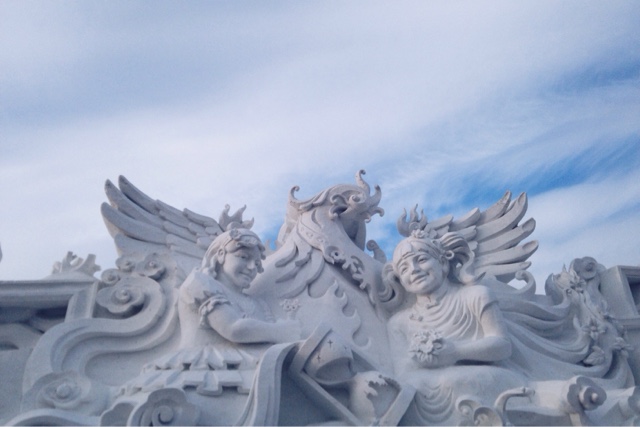
Again, it was really amazing to see the snow sculptures as well as the sculptors hard at work turning huge blocks of packed snow into intricately detailed sculptures. Some of them were absolutely huge, so I can't imagine how long it took to create. 

Huge snow castles and ice pagodas

I genuinely recommend anyone who finds themselves on this side of the world to take the plunge into minus-silly-degrees and visit Harbin during the Snow and Ice Festival. I'm so pleased to say that I have Harbin there, done that! 

SHARE:
© Miss Annie Ly. All rights reserved.
Blogger Template Designed by pipdig